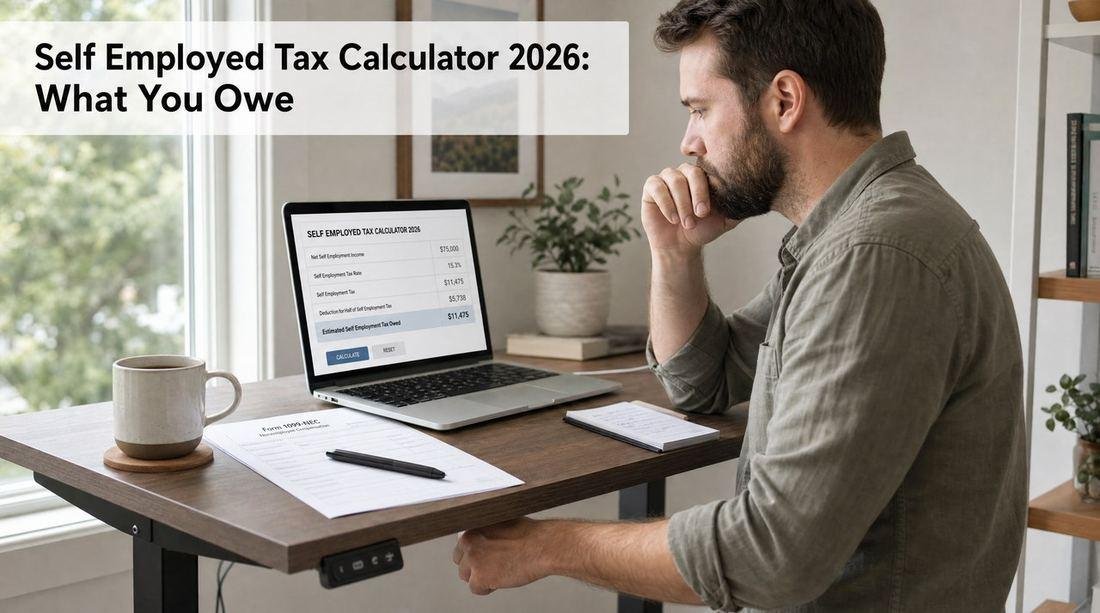
Self-Employed Tax Calculator 2026: SE Tax + Federal + State
Self-employed workers face a double tax punch: SE tax (15.3% on net earnings, both halves of FICA) AND regular federal income tax on the same money. This tool runs both calculations and shows your quarterly estimated tax payments for 2026.
The Self-Employment Tax Formula
SE tax is 15.3% of net self-employment earnings (gross income minus business expenses). It has two parts: 12.4% Social Security (on net earnings up to $184,500 in 2026) + 2.9% Medicare (no cap). High earners pay additional 0.9% Medicare on net SE income over $200,000 single / $250,000 joint.
The IRS gives a small break: you only pay SE tax on 92.35% of net earnings (the multiplier accounts for the deductibility of the employer half). And you can deduct half of your SE tax as an "above the line" adjustment to income on your 1040, lowering your federal income tax bill.
Example: $60,000 net business income. SE tax = $60,000 × 0.9235 × 0.153 = $8,478. Deductible portion (half) = $4,239. Adjusted gross income = $60,000 - $4,239 = $55,761 before standard deduction.
Quarterly Estimated Tax Payments (Form 1040-ES)
The IRS expects most self-employed workers to pay taxes throughout the year via four quarterly estimated payments. Missing them triggers underpayment penalty (currently 8% APR in 2026). Due dates:
- Q1: April 15, 2026 (for income earned Jan-Mar)
- Q2: June 15, 2026 (for April-May)
- Q3: September 15, 2026 (for June-August)
- Q4: January 15, 2027 (for September-December)
Safe harbor rules: you avoid penalty if total quarterly payments equal at least (a) 90% of current year tax liability, or (b) 100% of prior year tax (110% if AGI was over $150,000 last year). Most self-employed workers use option (b), pay the same as last year, calculate the difference at filing.
Top Schedule C Business Deductions
Every dollar of legitimate business expense reduces both your federal income tax AND your SE tax. A $1,000 deduction at the 22% bracket saves $220 federal + $153 SE = $373 total. Don't skip them.
Often missed:
- Home office deduction, simplified method allows $5/sq ft up to 300 sq ft ($1,500 max)
- Health insurance premiums, fully deductible if not eligible for employer plan
- Self-employed retirement contributions (Solo 401k, SEP-IRA), up to $70,000 in 2026 combined
- Vehicle mileage, 70 cents per business mile in 2026 (IRS standard rate)
- Cell phone (business portion), internet, software subscriptions
- Continuing education and professional licenses
- Half of SE tax (above-the-line adjustment, not Schedule C)
Common 1099 Tax Mistakes
Mistake 1: Not setting aside taxes from each payment. Rule of thumb: stash 25-30% of every check in a separate tax savings account. Higher earners should aim for 35-40%.
Mistake 2: Treating SE tax like income tax. It's a separate line on your 1040 (Schedule 2, line 4) and is not reduced by the standard deduction. Even if your federal income tax is zero, you may still owe thousands in SE tax.
Mistake 3: Not forming an LLC or S-Corp when income justifies it. At $80,000+ net business income, an S-Corp election can save $3,000-$8,000 per year in SE tax by paying yourself a reasonable salary plus distributions. Below $80,000, the added complexity usually isn't worth it.