🏛 2026 Update: The One Big Beautiful Bill (Public Law 119-21) is now law — our calculators reflect confirmed 2026 IRS rates including the $16,100 standard deduction & No Tax on Overtime deduction.
See 2026 Changes →
2026 Overtime Pay Calculator: No Tax on Overtime (OBBBA Confirmed)
Calculate your take-home pay AND your estimated 2026 tax savings from the confirmed No Tax on Overtime deduction (OBBB Section 70202, Public Law 119-21).
✓ OBBB Section 70202 Confirmed📊 2026 IRS Brackets🔒 No data stored💰 Shows future refund estimate
🏛 2026 No Tax on Overtime — Quick Facts (Public Law 119-21)
Deduction Cap
$12,500
Single filer/year
What's Deductible
0.5x
Overtime premium only
Phase-out Starts
$150K
Single MAGI
Valid Through
2028
Tax years 2025–2028
W-2 Code
Box 12
Code TT
🧮 2026 Overtime Tax Calculator with OBBB Savings
ℹ️
What's included: Federal income tax (2026 brackets) + Social Security 6.2% + Medicare 1.45%. The OBBB overtime savings box shows your estimated future refund — actual paycheck withholding is unchanged. Enter your MAGI for phase-out calculation.
Pay Type
Hours worked over 40/week at 1.5x rate — must be FLSA required (not California daily OT)
Enter your estimated annual gross income. Phase-out begins at $150,000 (single) / $300,000 (married).
Your Take Home Pay (Per Paycheck)
$0.00
per period
💰 2026 OBBB Tax Strategy Summary (Section 70202)
Overtime Premium (0.5x deductible portion)—
Your Adjusted Deduction Cap (after phase-out)—
Annual Qualifying Deduction—
Estimated Federal Tax Savings—
💡 How to claim: Your employer reports qualified overtime in W-2 Box 12, Code TT. You claim this on Schedule 1-A of your 2026 Form 1040 to receive this as a larger refund or reduced tax bill. FICA taxes (SS + Medicare) still apply to your full overtime pay — only federal income tax is affected.
Description
Per Paycheck
💵 Gross Pay (incl. overtime at 1.5x)
—
🏛 Federal Income Tax (withheld)
—
🔒 Social Security 6.2%
—
🏥 Medicare 1.45%
—
🗺 State Income Tax
—
Total Deductions
—
✅ Net Take Home Pay
—
⚠️ Paycheck withholding is a bracket-based estimate. The OBBB savings box shows a future refund estimate — actual withholding does not change. Consult a tax professional for exact figures.
How the 2026 No Tax on Overtime Deduction Works
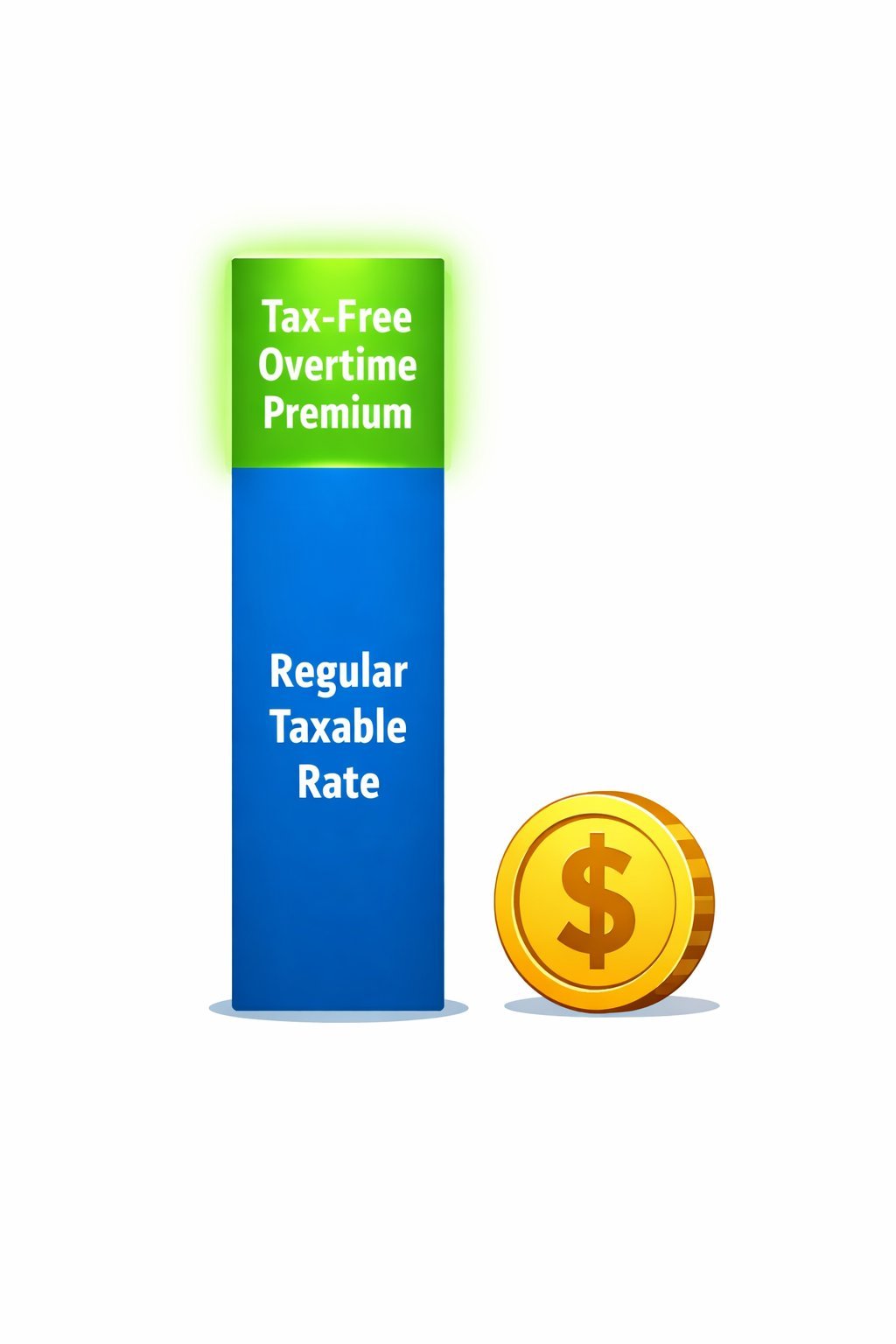
The One Big Beautiful Bill (OBBBA), signed into law July 4, 2025 as Public Law 119-21, created a new federal tax deduction specifically for overtime workers. Under Section 70202, the "overtime premium" — the extra 0.5x portion of your time-and-a-half pay — is now deductible from federal income tax.
The Three-Step Overtime Deduction
1
Worked FLSA OT?
Hours over 40/week at 1.5x rate qualify
2
Identify Premium
0.5x portion = deductible amount
3
Claim Refund
File Schedule 1-A — get it back at tax time
The Math: How It Works
If your regular rate is $20/hour and you earn $30/hour for overtime, the deductible premium is $10/hour (the 0.5x portion). The full $30 is still taxed on your paycheck, but at filing time you claim the $10/hour premium as a deduction — effectively getting that portion back as a refund.
2026 Phase-Out Table
Annual Income (Single MAGI)
Max Overtime Deduction
$0 — $150,000
$12,500 (Full)
$160,000
$11,500
$175,000
$10,000
$200,000
$7,500
$237,500
$3,750
$275,000+
$0 (Fully Phased Out)
Married filers: $25,000 max cap, phase-out begins at $300,000 MAGI.
Who Qualifies?
✅ W-2 non-exempt hourly employees covered by FLSA
✅ Hours worked over 40 in a workweek at 1.5x minimum
❌ Exempt salaried employees (executive, administrative, professional roles)
❌ 1099 independent contractors and self-employed workers
❌ California daily overtime (8-hour rule) unless you also exceed 40 hours/week
Under Section 70202 of the One Big Beautiful Bill (Public Law 119-21), W-2 employees can deduct the 'overtime premium' — the 0.5x extra portion of time-and-a-half pay — from federal income tax. This is a below-the-line deduction claimed on your tax return, not a change to paycheck withholding. For example, if you earn $20/hr and work overtime at $30/hr, only the $10 premium is deductible, up to $12,500 per year.
No. Your employer still withholds federal income tax on all wages including overtime. The OBBB creates a deduction you claim when you file your 2026 tax return, effectively giving you a larger refund or reduced tax bill. Our calculator shows you your 'future refund estimate' so you know what to expect at filing time.
Yes. The No Tax on Overtime deduction only applies to federal income tax. Social Security (6.2%) and Medicare (1.45%) are still withheld on all wages including overtime — there is no FICA exemption in the OBBB.
The OBBB limits the deductible overtime premium to $12,500 per year for single filers and $25,000 for married filing jointly. This means once your qualifying overtime premium reaches $12,500, additional overtime no longer generates a deduction. For example, at $20/hr, you'd need to work approximately 1,250 overtime hours to hit the cap.
The deduction applies to non-exempt W-2 employees covered by the federal Fair Labor Standards Act (FLSA). This means you must be classified as a non-exempt hourly worker and your overtime must result from working more than 40 hours in a workweek. Exempt salaried employees, 1099 contractors, and self-employed workers generally do not qualify.
Yes. If your Modified Adjusted Gross Income (MAGI) exceeds $150,000 (single) or $300,000 (married filing jointly), the $12,500 cap is reduced by $100 for every $1,000 over the threshold. At $275,000 MAGI (single), the deduction is fully phased out. The calculator on this page includes the phase-out calculation automatically.
Generally no. California requires overtime for hours worked over 8 in a single workday, even if you work fewer than 40 hours total in the week. The OBBB deduction only applies to overtime required by the federal FLSA — hours over 40 in a workweek. California daily overtime beyond the FLSA requirement typically does not qualify unless you also exceed 40 hours in that workweek.
For tax year 2026, employers will report your qualified overtime compensation in Box 12, Code TT on your W-2. You enter this amount on Schedule 1-A of your Form 1040 to claim the deduction. Keep track of your overtime hours throughout the year so you can verify your employer's Box 12 amount when you receive your W-2 in January 2027.